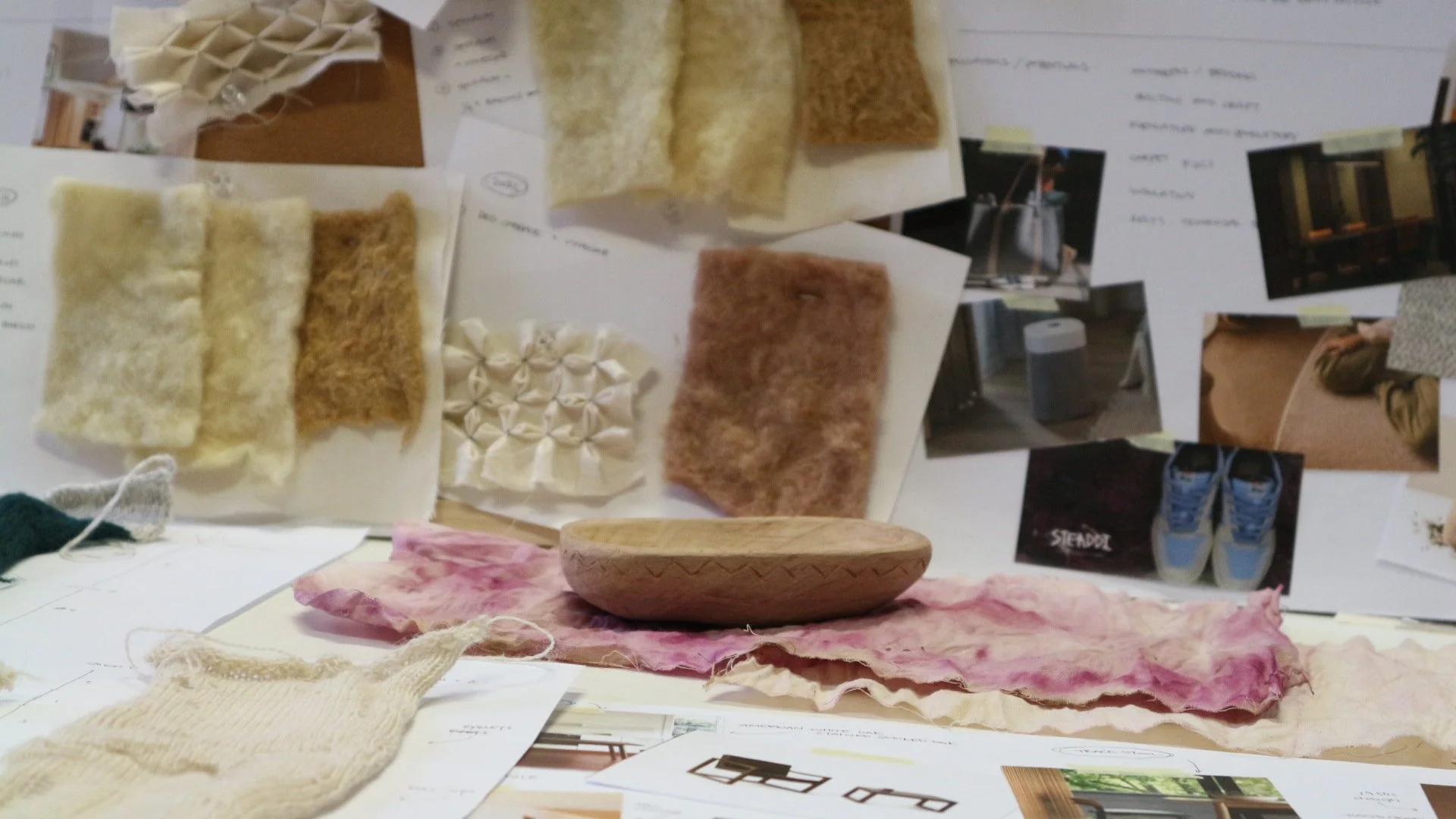
Week 2: Cooking with gas!
Current research question:
How can underutilised/wasted local New Zealand materials be explored in products for the home environment, to preserve and tell the rich story of culture and history of land and people in New Zealand?
Week two focused on reflecting on the work from week one, receiving peer-to-peer feedback, and further developing these efforts to produce 16 new artefacts. This process enabled me to be more intentional in my making and to further establish a connection between the practice and our research question.
Presenting my artefacts (week 1)
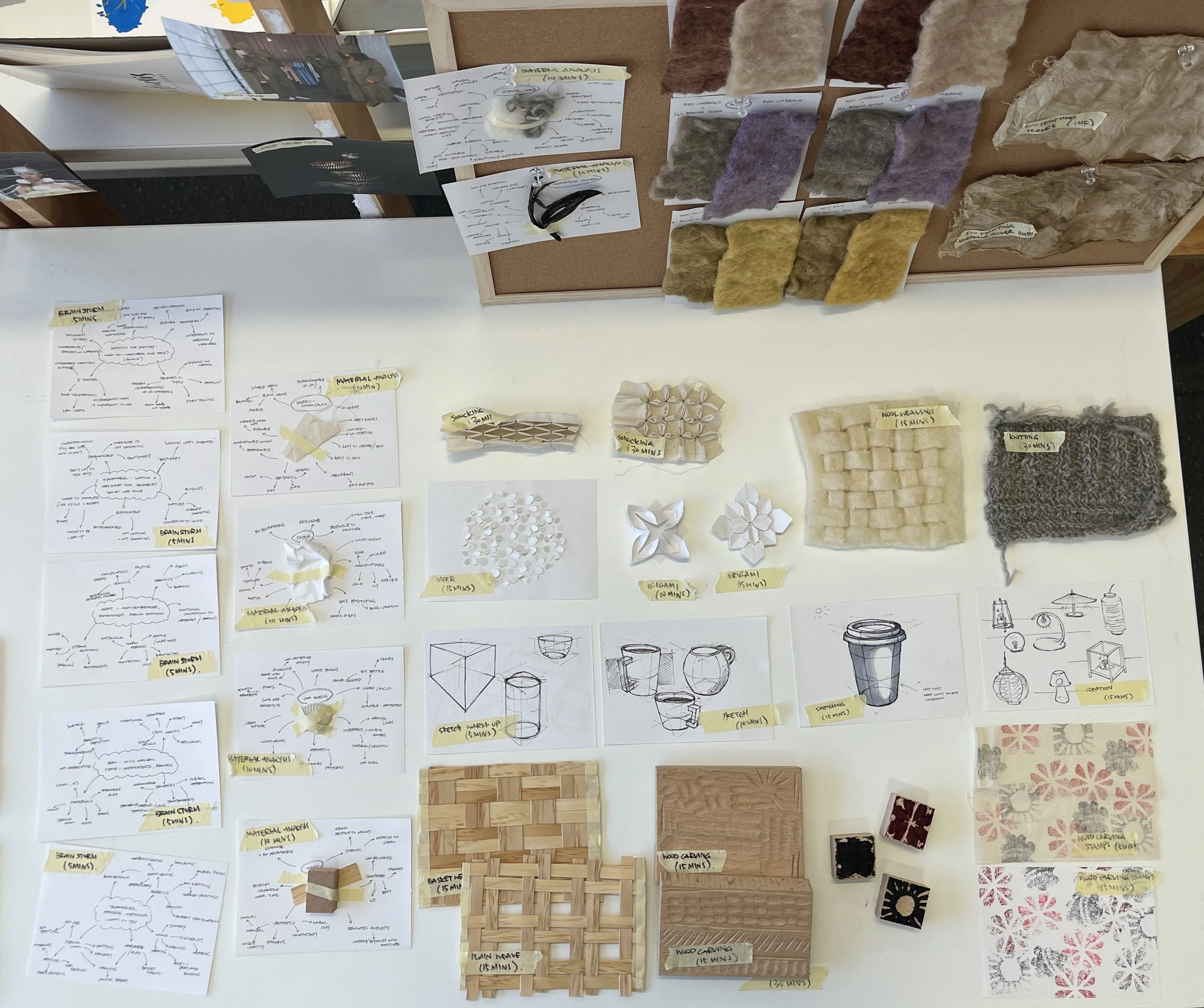
The visual presentation and layout of my artifacts were done with a purpose: to display my process to draw people in and to clearly communicate the process I followed (from planning and research and material analysis to experimenting and learning into creating). Laying out my artifacts this way brought my making and thinking together, highlighting the progression and development throughout the week. The feedback sessions were extremely beneficial. I received positive, constructive feedback outlined below, but I also asked a question I needed help with. Which was “I am working with Maori cultures and New Zealand materials, but I am struggling to navigate the balance between designing with Maori influences or designing with my own
cultural influences (Japanese, Chinese). Not being Maori myself, I would love to understand and appreciate New Zealand history, but I am unsure how far I can go responsibly and how much of myself I should put into this too”. My group started a discussion, and most said I could blend the two. Seeing connections and similarities between the two could be interesting as well, as there are overlapping traditional practices, such as wood carving. This would bring an element that only I could bring into the design world. Another mentioned that, as the designer, I will always be part of the product, as my background and values will influence how I design.
‘…careful craftsmanship is also about putting yourself into the product.’ - fellow classmate 2026
Group feedback
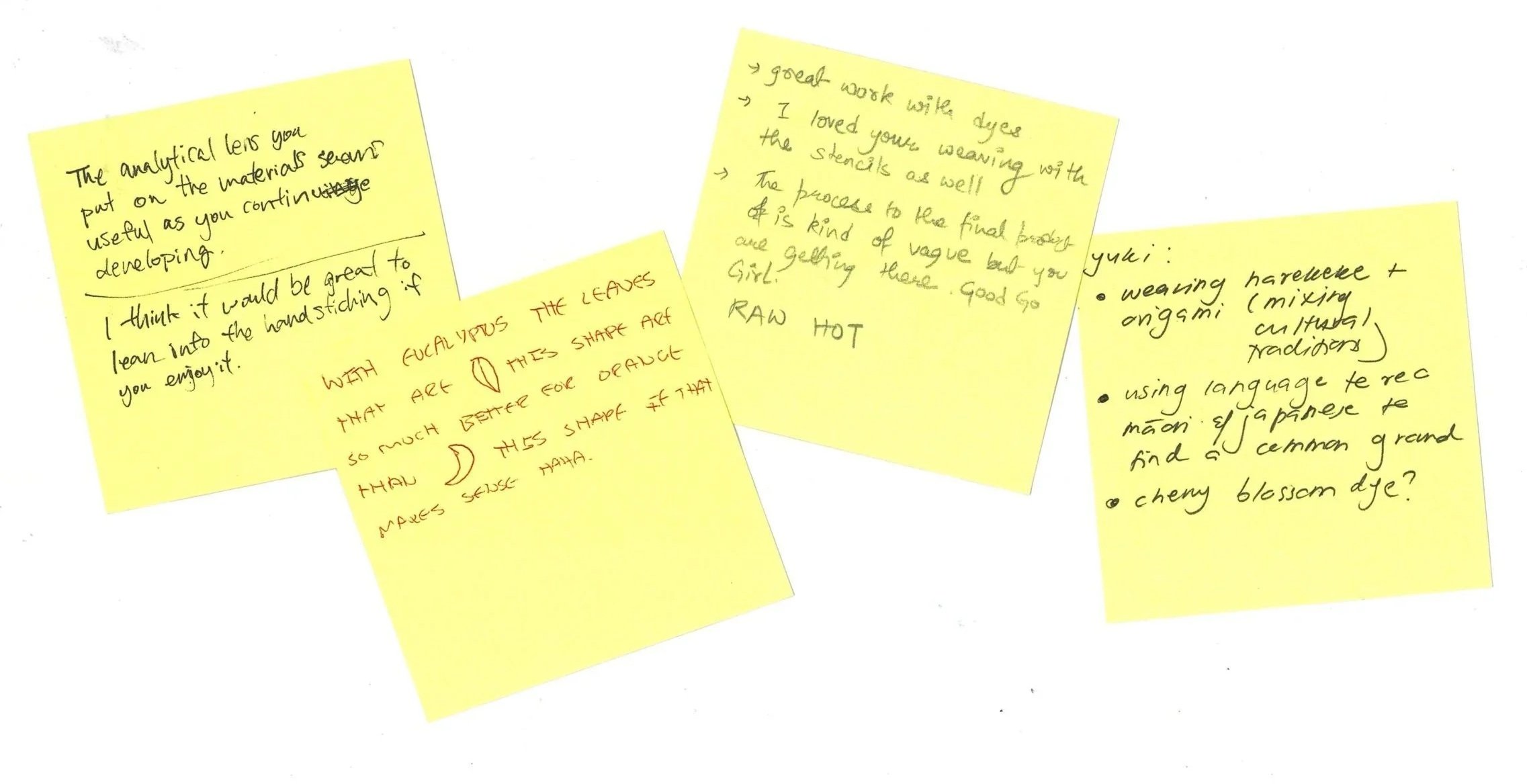
I was advised to lean into the methods of making I enjoy most, like handsewing and eco-dyeing, as I sounded very passionate about them. My next step would be to combine methods and practices to see the in-between and further develop techniques and materials. An
interesting feedback was about mixing cultures and combining traditional practices, for example, how could Maori weaving be combined with Japanese origami methods?
I am interested in experimenting with materials and methods, working together in unexpected ways to understand relationships and the in-between of these combined. ‘Amalgamate’ could also relate to finding connections between cultures and people.
Subtract: to take away from another, decrease in size, amount, number and so on.
‘Subtract’ is relevant to my values regarding transparent making processes. I aim to eliminate unnecessary processes to create as naturally and raw as appropriate, reducing the risk of damage and waste.
Choosing two descriptive terms
From a new list of descriptive terms (delaminate, reconstitute, layer, dissolve, aerate, eviscerate, glaze, amalgamate, substitute, subtract, morselate), I defined and thought about each term in relation to my research hunch. I chose two that were the most relevant to my practice:
Amalgamate: combining or uniting to form one structure.
Time constraint: Yield will be rationed to….
4 @ 15 minutes
4 @ 30 minutes
4 @ 1 hour
4 @ 2 hours
Total number of postcard-sized artefacts to present next week in class time: 16
Brainstorming: 1 artefact at 15 minutes
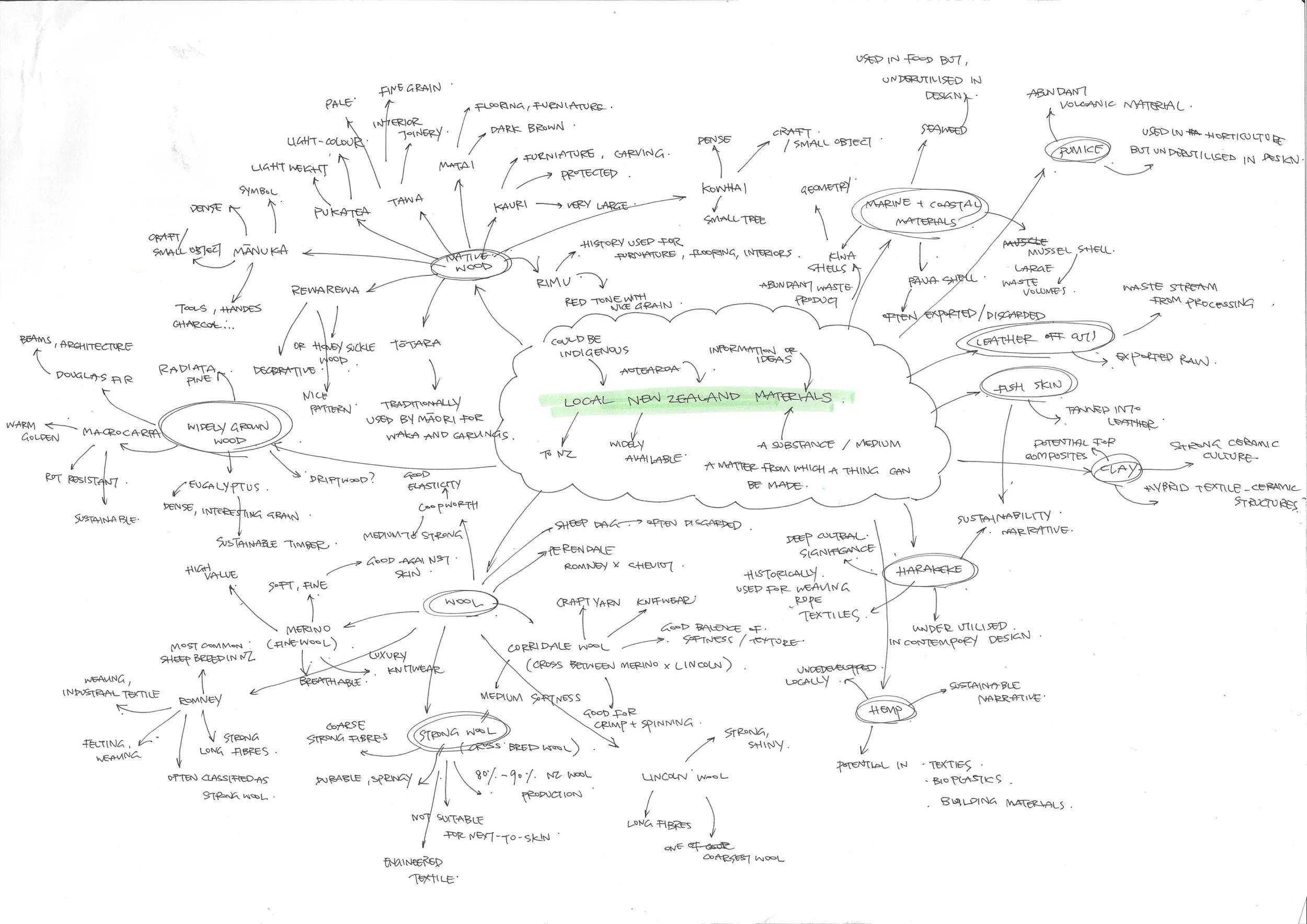
To begin this week, I started with brainstorming. My design style, unfortunately, still didn’t let me get messy and get straight into making. I brainstormed some local New Zealand materials. The goal was to understand my area of interest further and to be more intentional in my making so it is relevant to my research question. I was
Designer inspiration: 1 artefact at 15 minutes
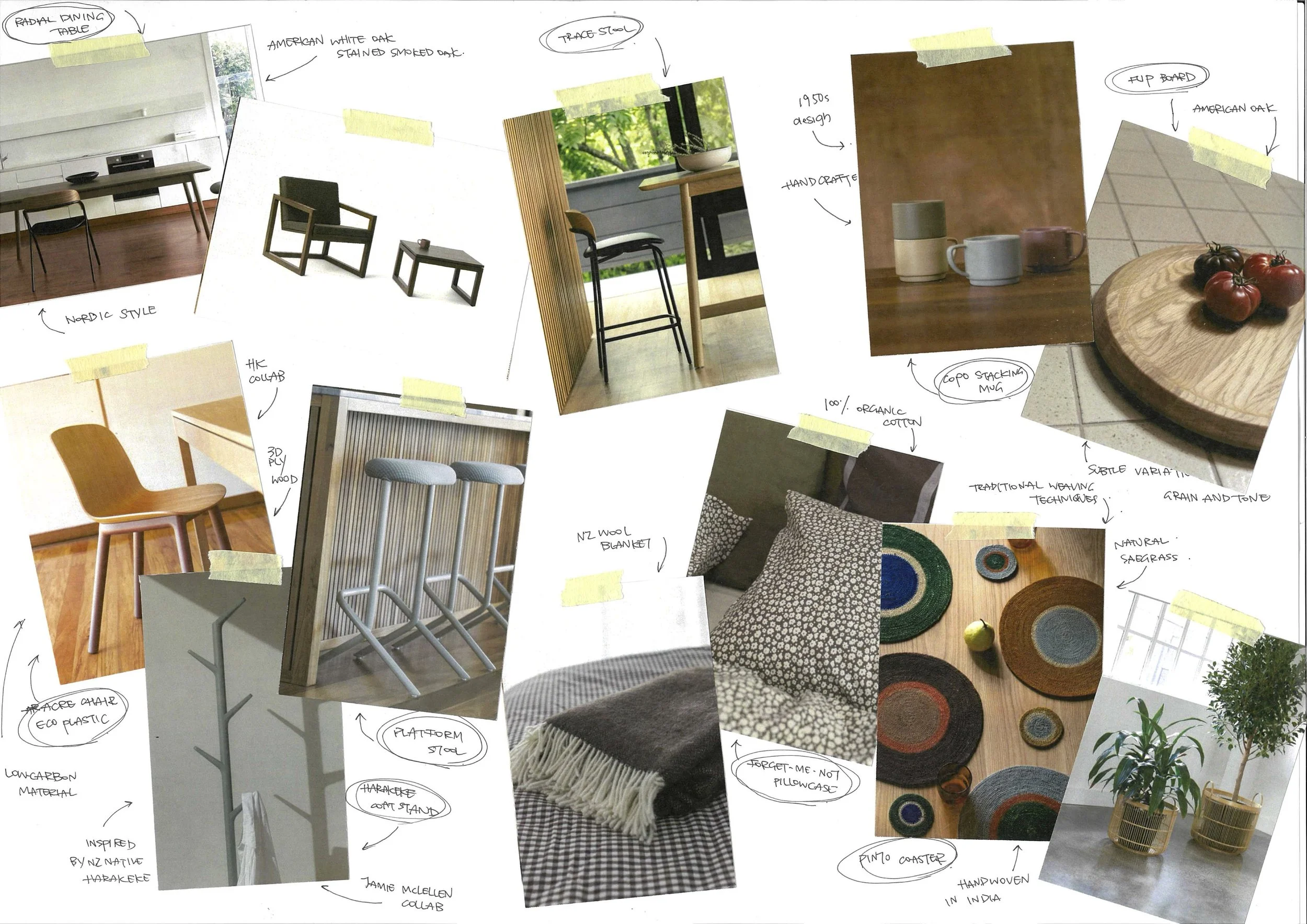
This was an important step for me to ensure I was exploring in the right direction. Although I had browsed Citta’s product line and researched their core values, I had never carefully analysed their products. Creating a board of the products that stood out to me helped me understand their design style. They lean towards minimalistic designs while keeping colours playful and modern. I felt a calming, warm undertone to all their products, which is also similar to my design aesthetic. I was most interested in how they incorporate
Research: 2 artefacts at 15 minutes
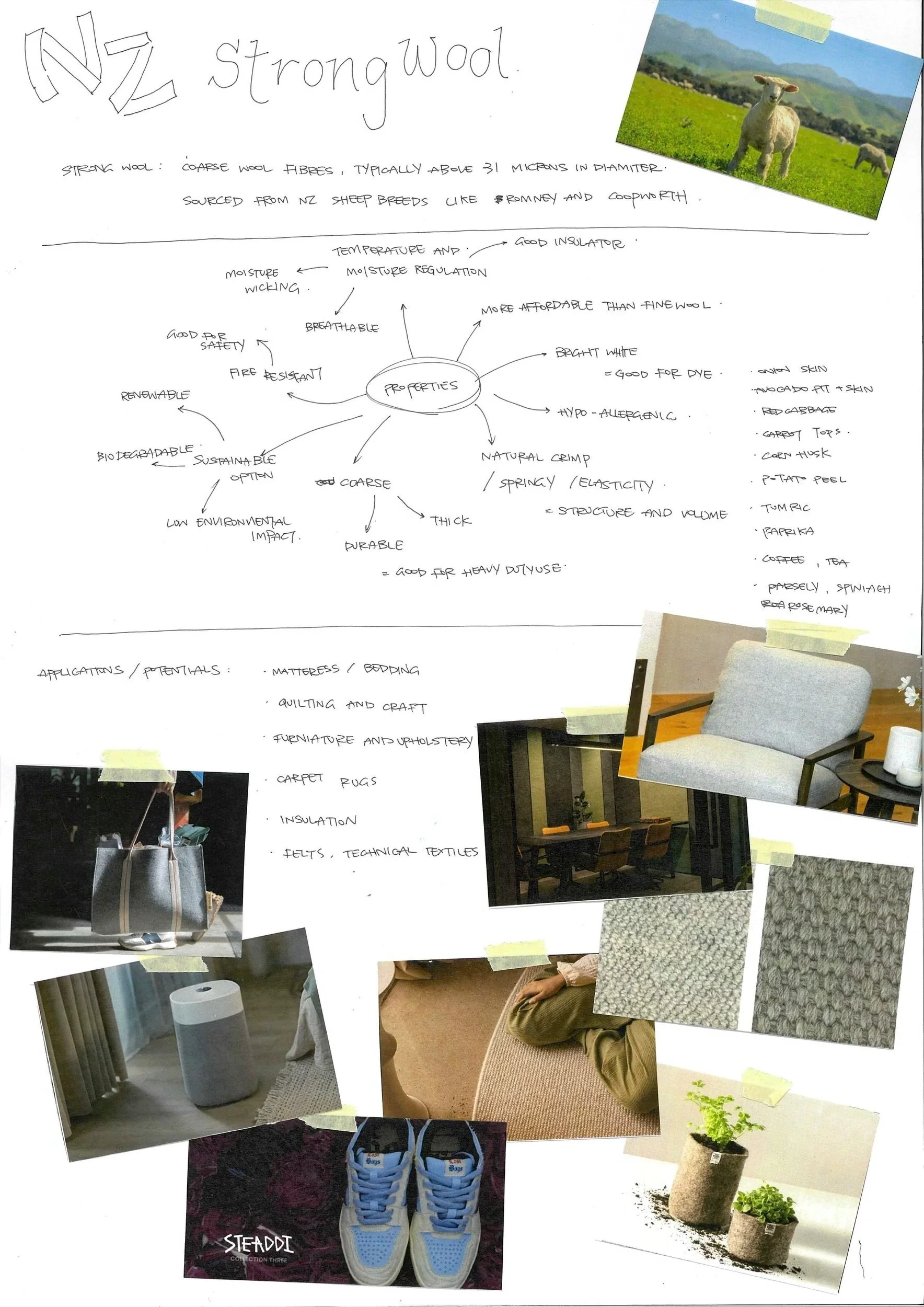
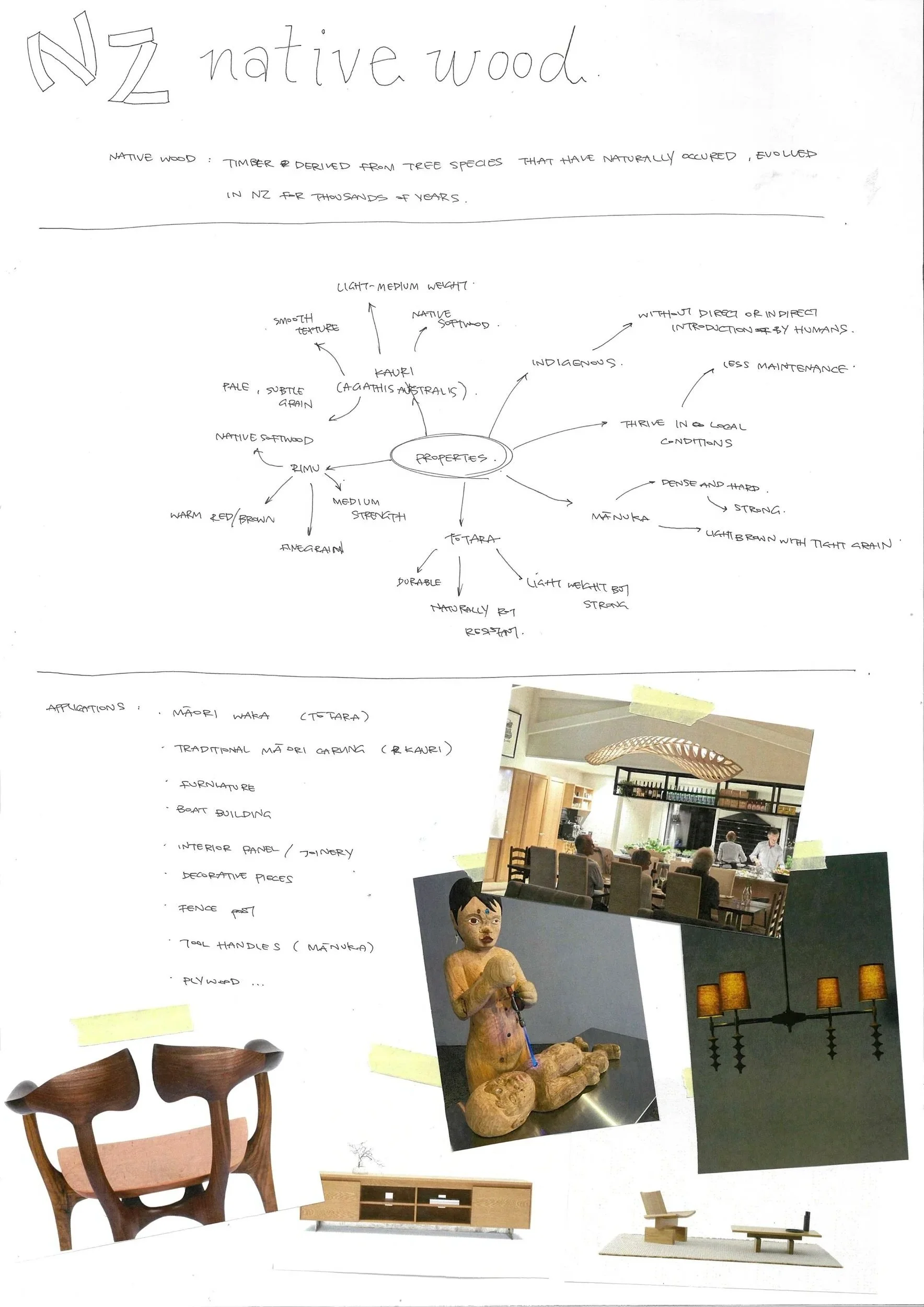
Last week, I brainstormed the properties of each material I had collected. This week, to expand on this research, I looked at how these properties are currently applied in design. I primarily looked at New Zealand designers who had interesting ways of interpreting a material.
different cultures seamlessly into their design. For example, using traditional Indian weaving for their placemats, or drawing inspiration from Nordic design and collaborating with designers around the world.
I was particularly surprised by the variety of products made from strong wool. From using the biodegradable nature and moisture-regulating nature of the fibre in plant pots, to utilising the hypoallergenic benefit in rugs.
Eco dye: 5 artefacts at 1 hour and 2 hours
16 Artefacts
Use ‘amalgamate’ and ‘subtract’ to guide the generation of creative practice and reflection this week. The constraints this week are:
Scale constraint: Standard A3 size artefacts (297 x 420mm)
N.B. These artefacts can be 2 or 3 dimensional or a mixture of both. The artefacts may be displayed individually or composited into a small book (e.g. flip book), animation, or series of 3d artefacts.
Eco printing: 2 artefacts at 1 hour
Knitting (domestic knitting machine): 2 artefacts at 2 hours
Wood carving (die grinder and carving): 2 artefacts at 1 hour and 2 hours
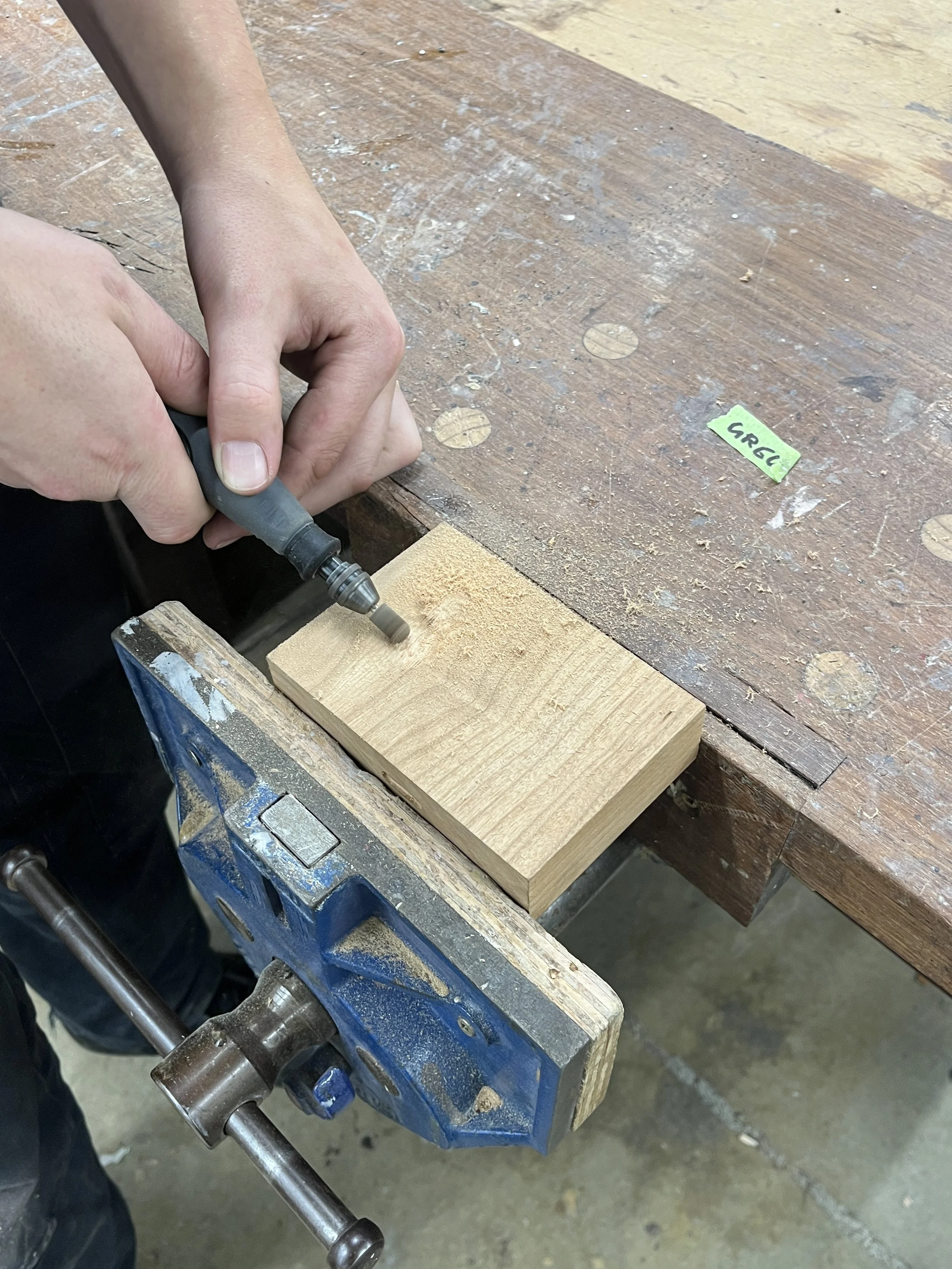
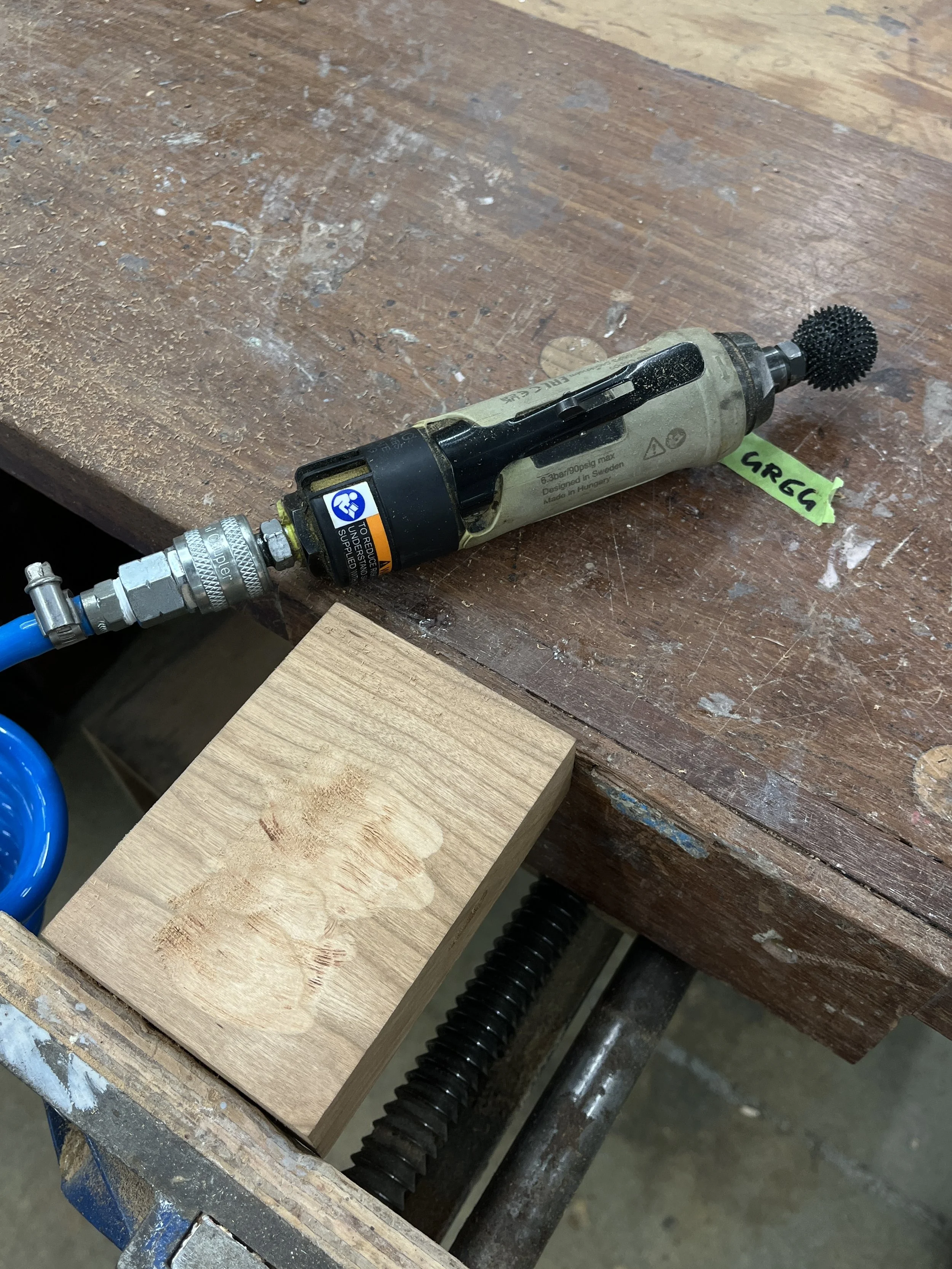
As mentioned, I enjoyed the wood carving last week. I wanted to take it a bit further by exploring sculpting and shaping the wood rather than just detailing. These were both new skills to me, but I was taught the basics of each machine. Firstly, we tried the Dremel, but it was too weak against the cherry grain, so we opted for a higher-power tool: the die grinder. This was more efficient but still required precision
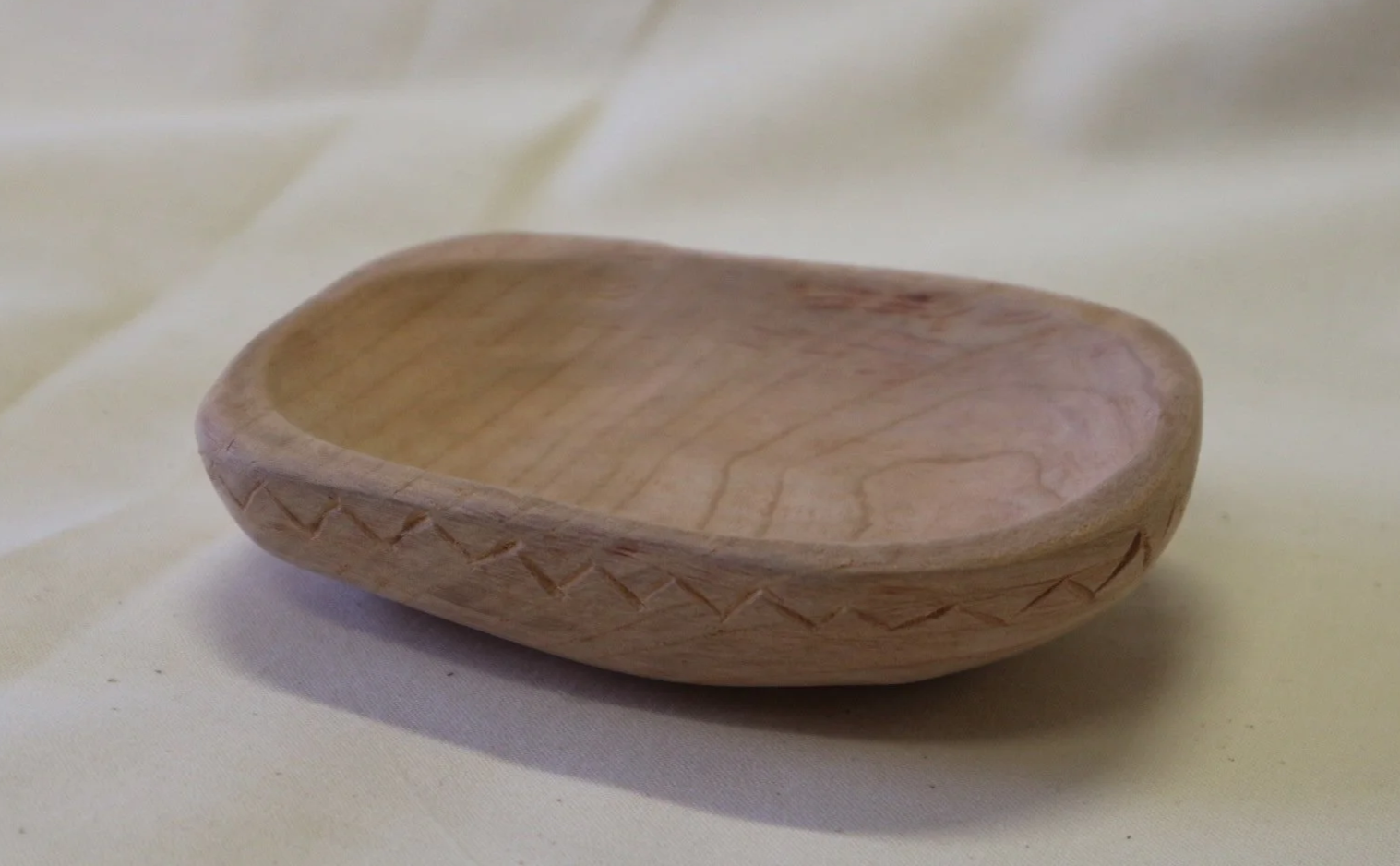
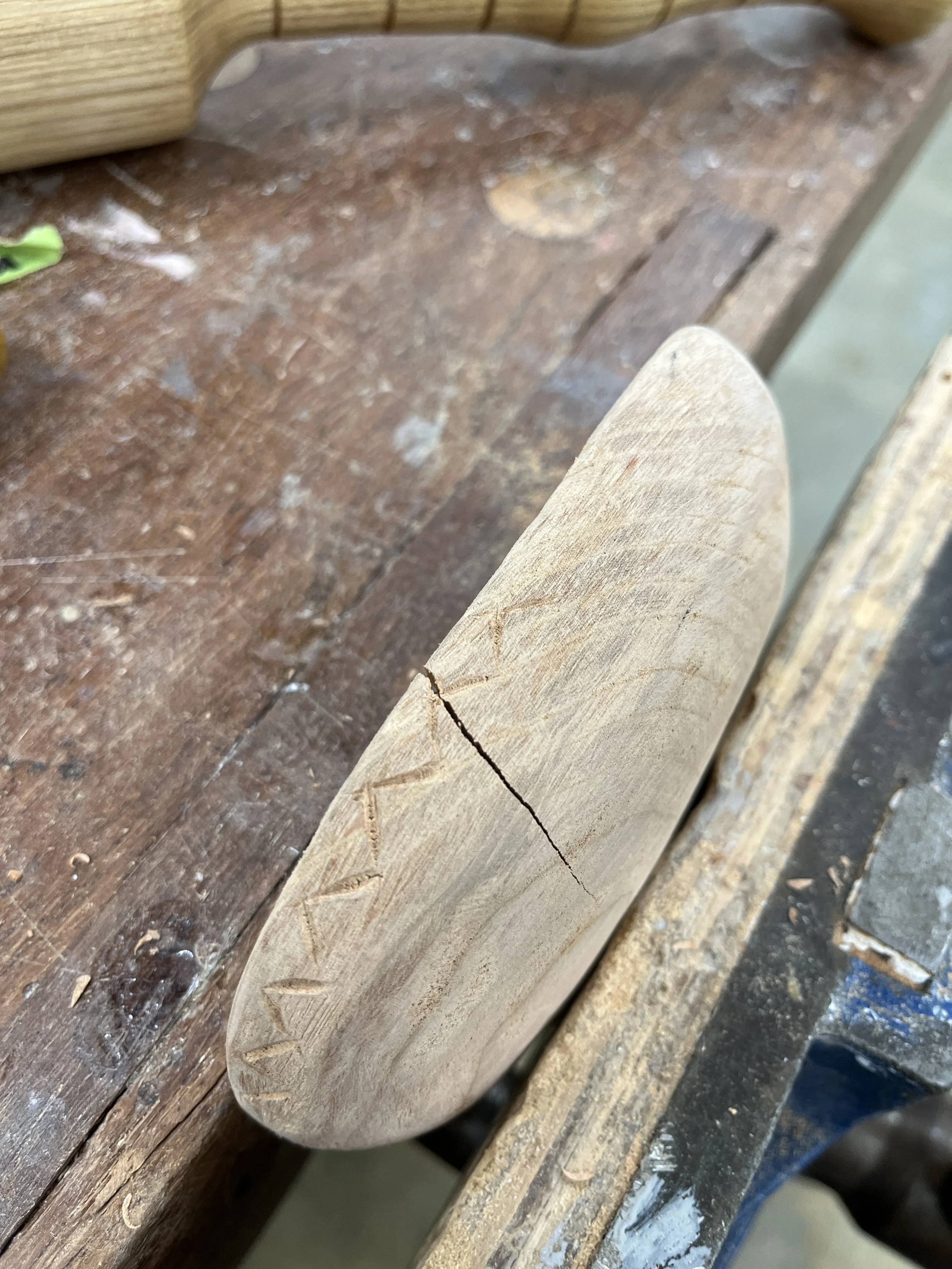
and time. Spending time with the wood taught me that understanding the grain in relation to the tool and having good control of your making. After sanding and filing the sculpted shape, I began combining skills from my previous learning: wood carving with a chisel.
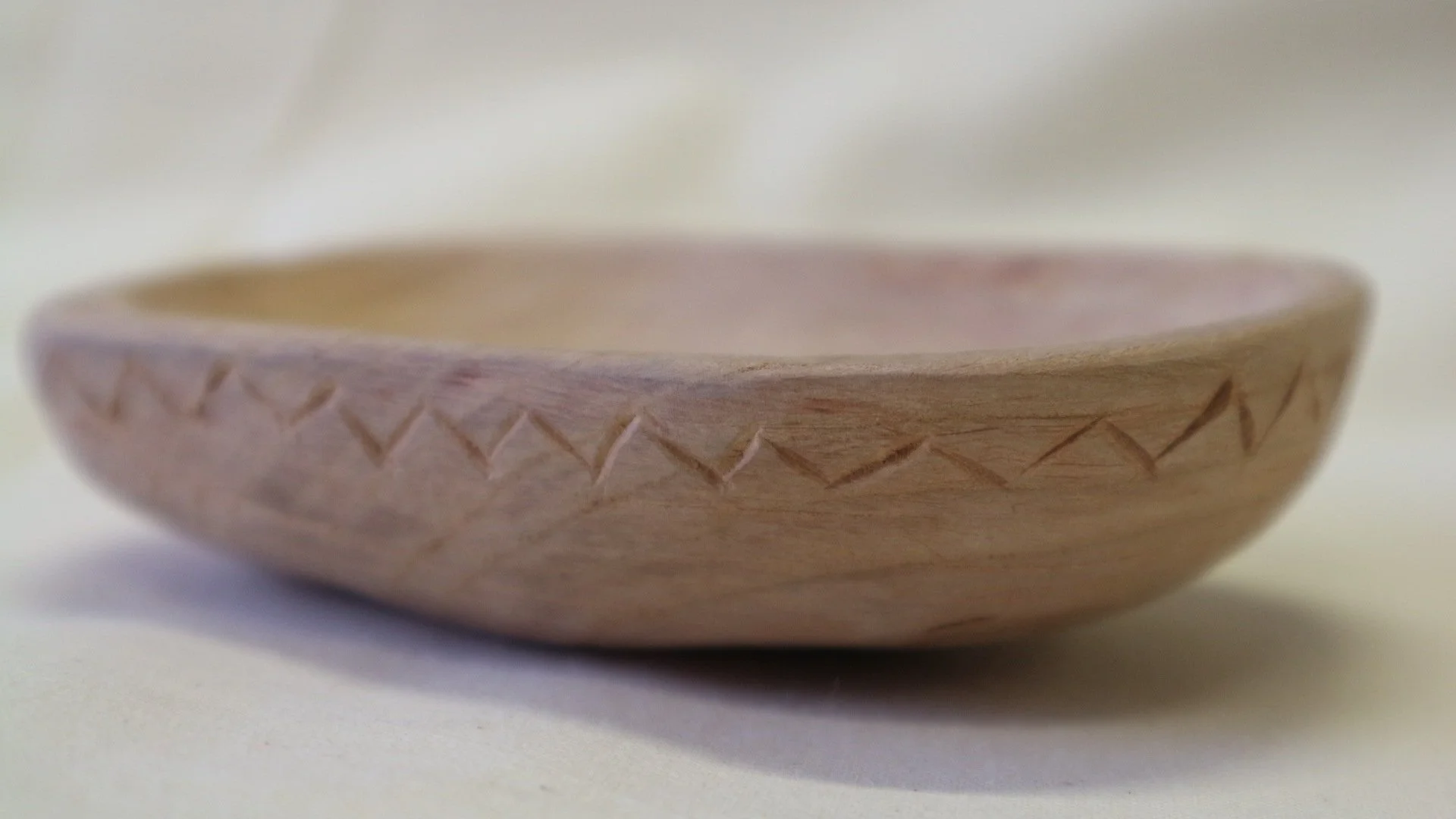
‘…tools are an extension of your hand; extension of your mind.’ - 3d labs technician 2026
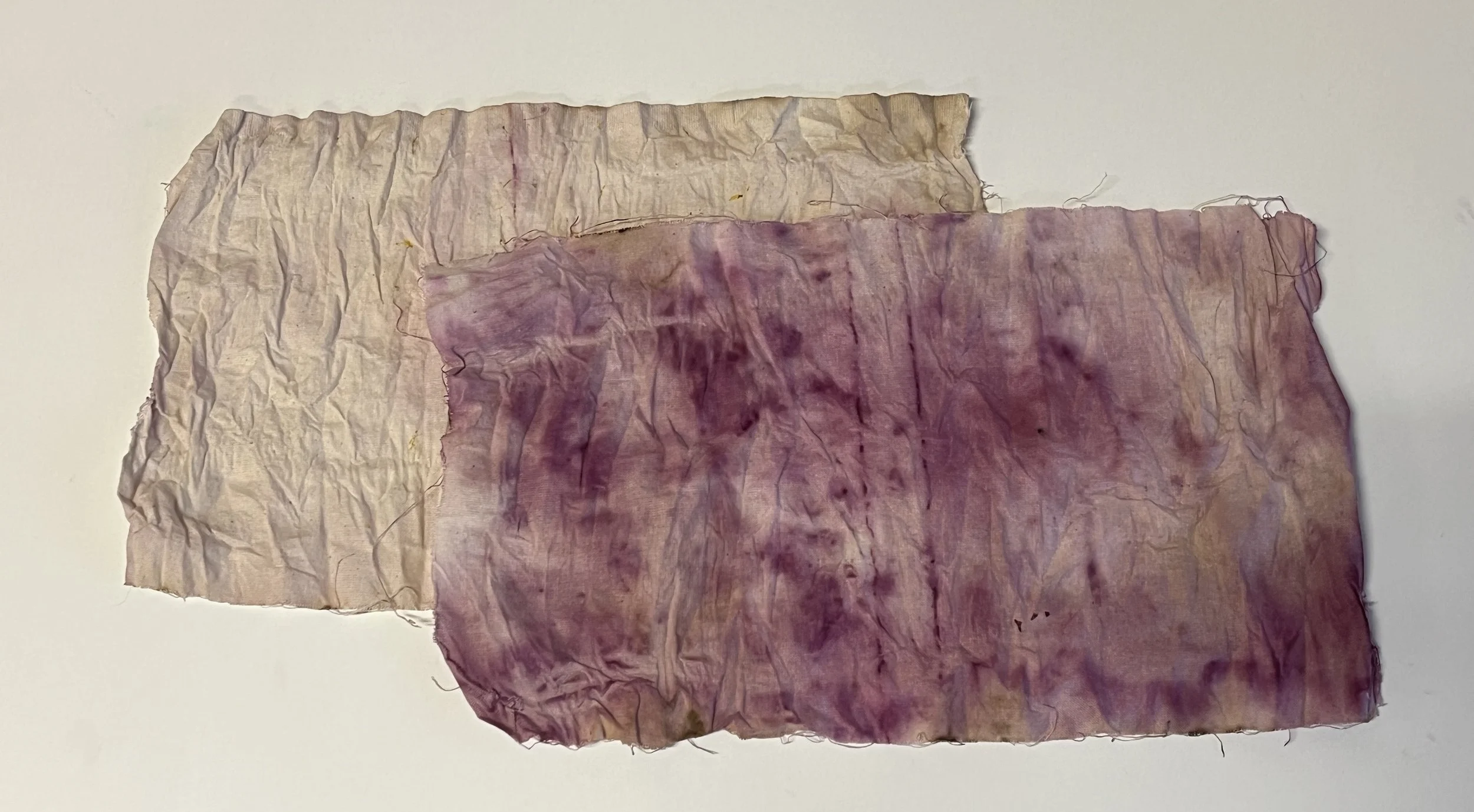
Last week, I was slightly disappointed by the lack of vibrant colours and shapes on the fabric, which was maybe to be expected from dry, dead leaves. This week, the red roses I experimented with produced a beautiful magenta colour, while the chrysanthemums left no pigment behind. Neither left any clear shapes or petal prints. I have succeeded in printing before, but unfortunately could not reproduce the same results. Could this be due to a difference in fabric choice?
This week, I tried blueberry and spinach and experimented with vinegar and baking soda. Each catalyst changed the hue in its own way. Looking over all of my ecodyes, I can see that the pure vegetables tend to produce the most vibrant colour, and this gets brighter over time. The swatches with baking soda all have a darker, almost mouldy colour.
beauty hidden in the materials closest to us, often overlooked or wasted. Through research on contextual review, I learned that chemical dying processes are extremely harmful to our waterways. It feels unsettling knowing that toxic methods are prioritised over natural dying, which is so simple.
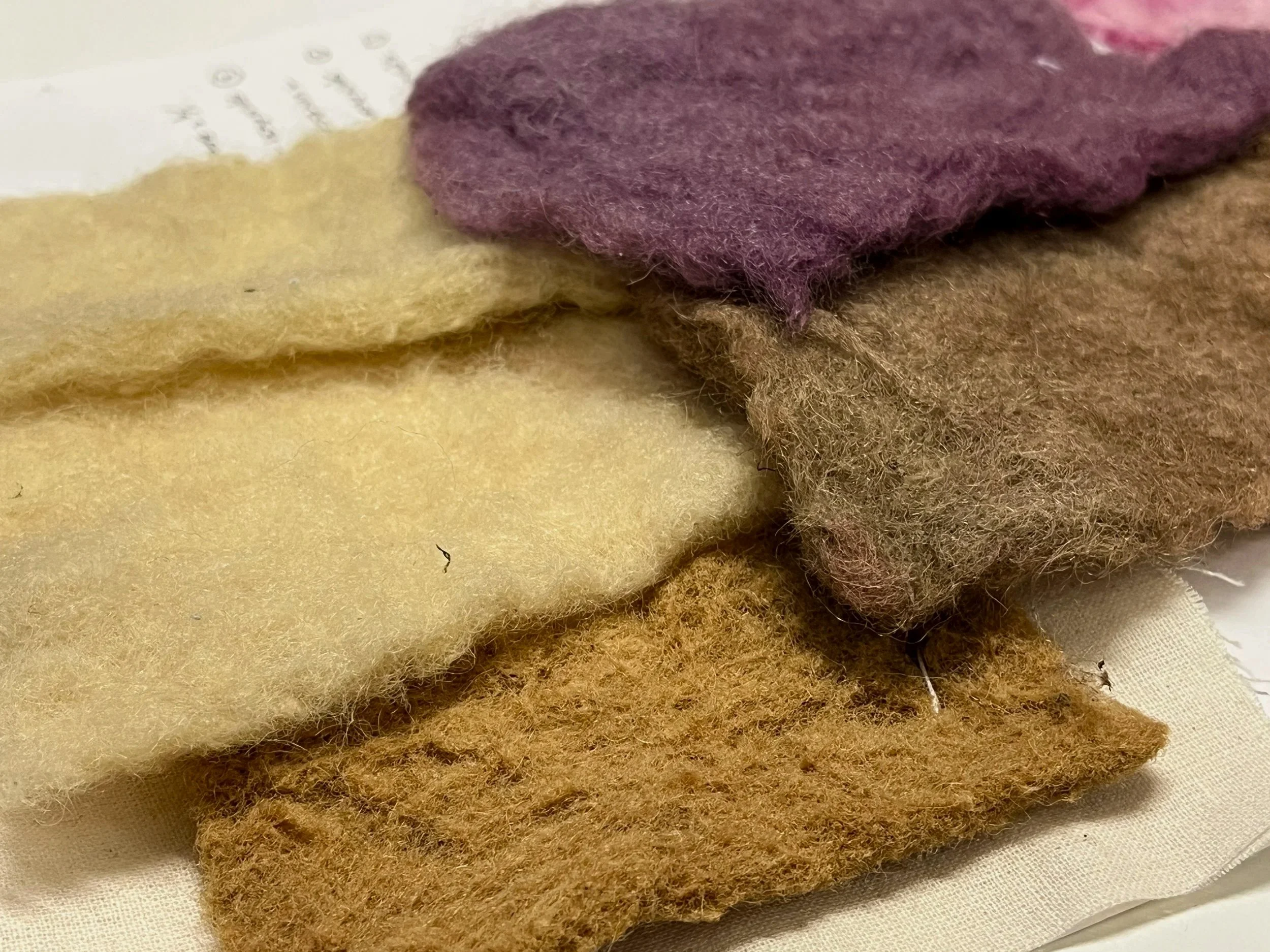
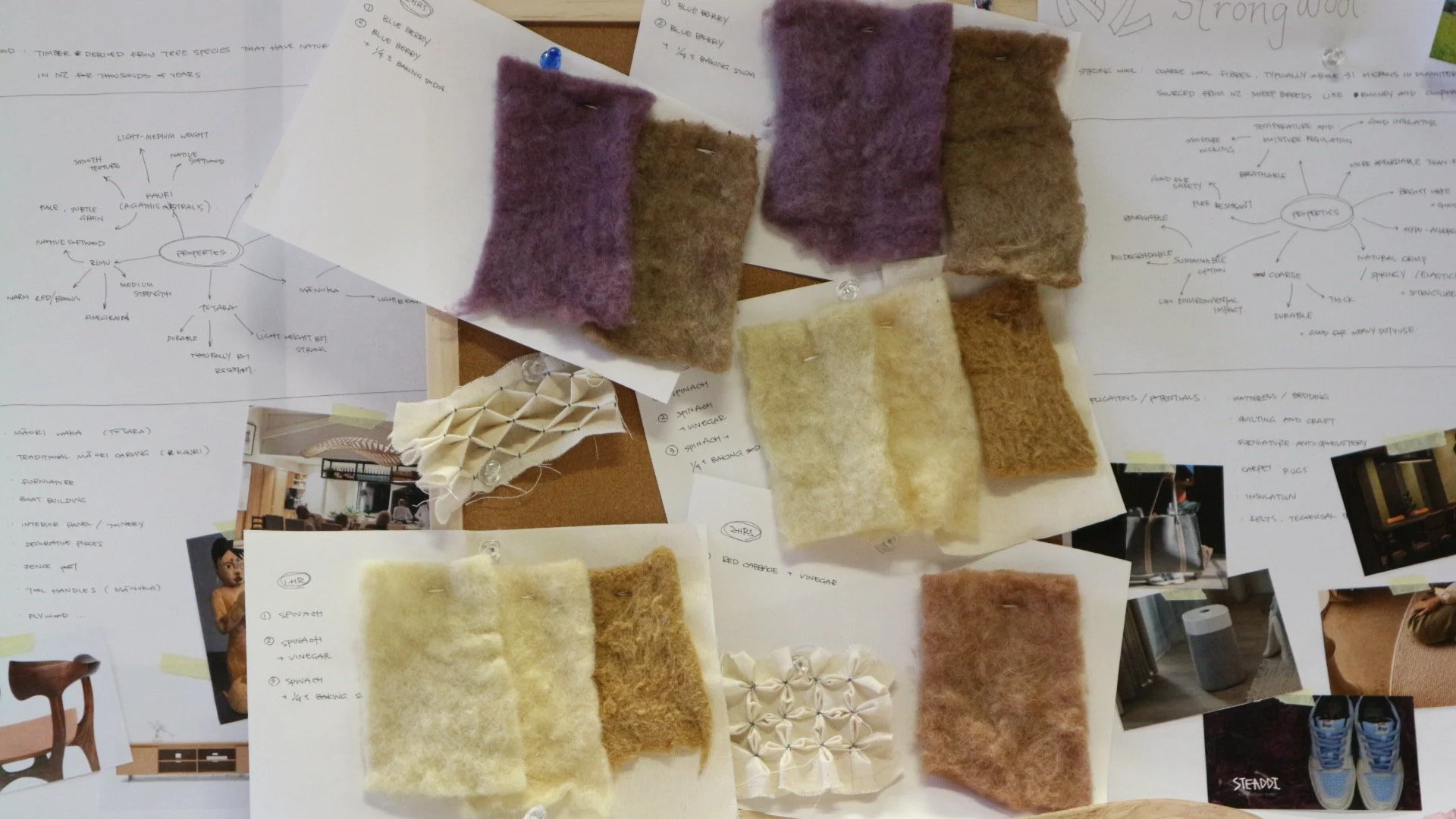
Here is where I started making, I do admit it is a lot later in the process than I would like to start. Last week I enjoyed this method but couldn’t grasp the ‘why’. By recognising my thinking throughout the making, I realised I was enjoying the simplicity and transparency of the process. I used scraps from my dinners and easily accessible supermarket produce to extract the natural dye. This made me feel the
The most interesting insight I got from this experiment and a few feedback sessions was realising that the most valuable research comes from unexpected outcomes. Specifically, the ‘spinch and baking soda’ test came out different to all other wool swatches despite following the same process. This swatch didn’t dry, even after leaving it overnight; I could feel the wool fibres trapping the water particles. I
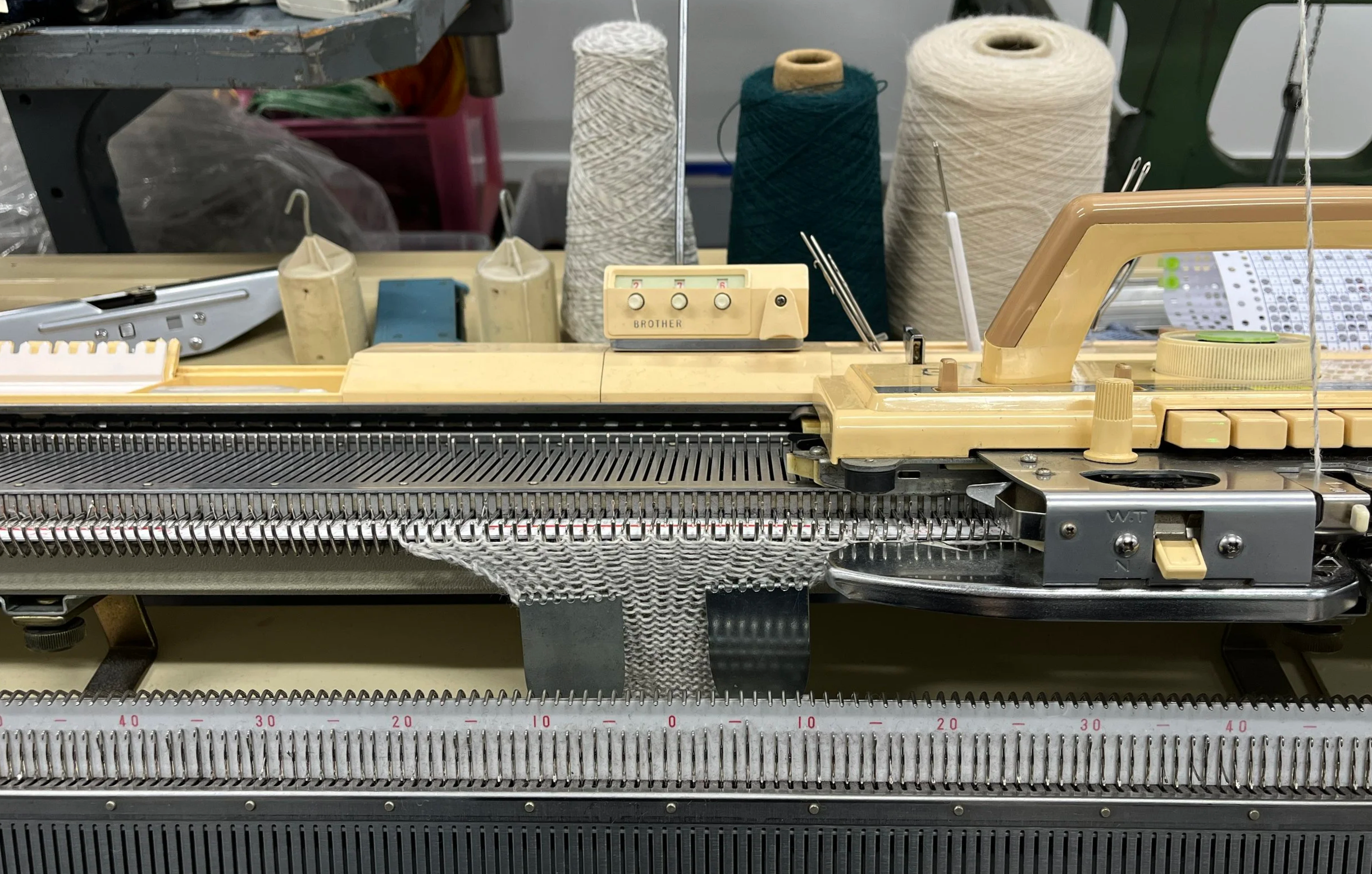
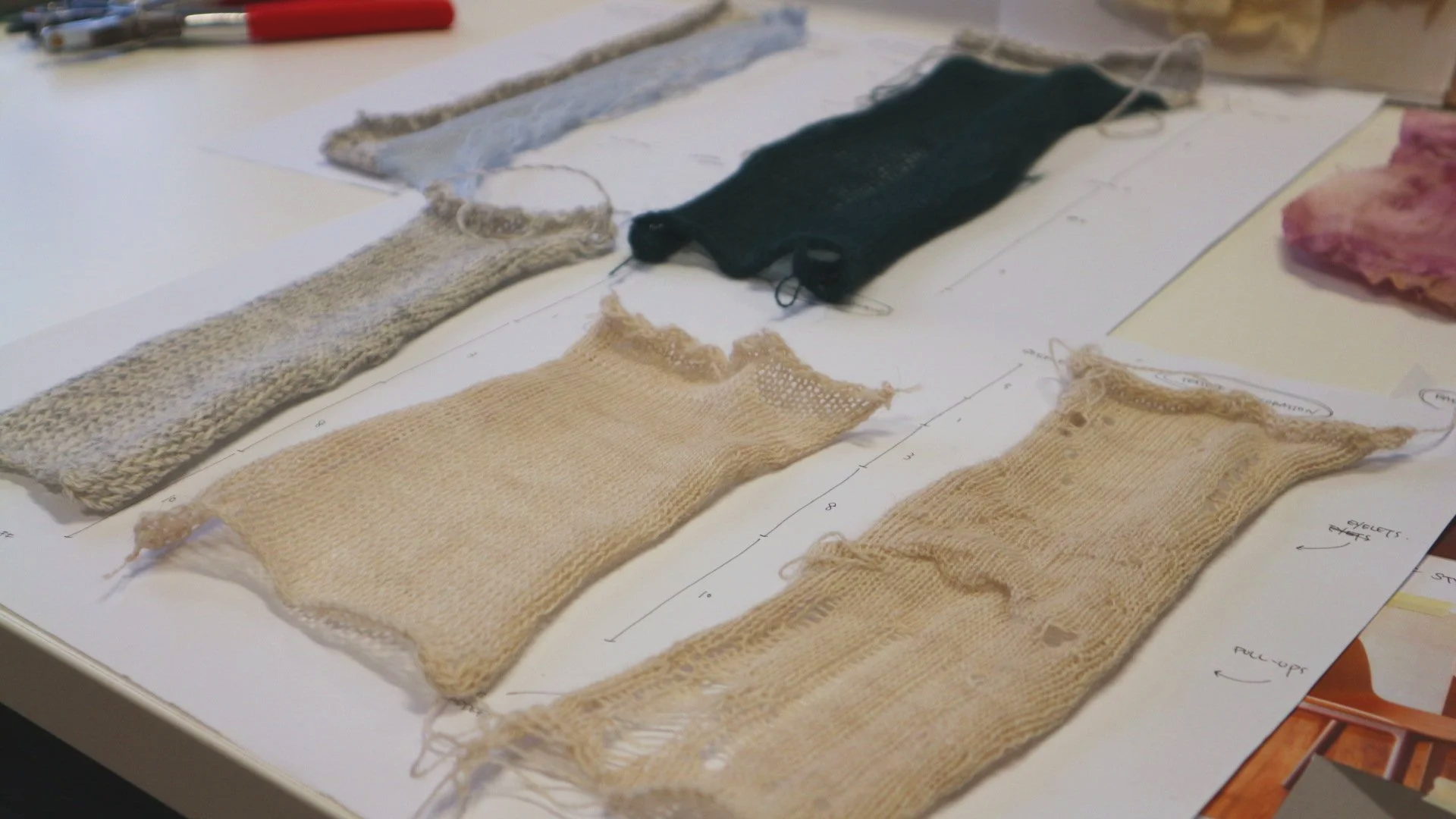
Expanding on my hand-knitting last week, I wanted to take it further and learn a new skill: the domestic knitting machine. This proved to be a great middle ground between analogue making, where you have most of the control, and digital machine making. I like how the machine lets me still feel connected to the making while achieving a professional finish. Understanding the machine and getting a feel for the basics took some getting used to, but my learning accelerated as I started getting into textures and techniques. As this is a new process for me, I am excited about the different knit textures and the possibilities this machine offers.
able to define what I meant by ‘local materials’ and therefore refine the materials I was interested in. It helped to understand what was available and the significance each has to this land. Breaking down terms and mapping out each material was helpful for my understanding.
had to force the wool to dry with a hair dryer, but in turn, this may have damaged the fibres (as overboiling can). This made the swatch shrink and resulted in an interesting texture, rough and bouncy. I learned that good research can come from being messy and exploring rapidly.
200 word narrative
200 word narrative
Aotearoa is known for its beautiful landscapes and unique wildlife. We are extremely privileged to be surrounded by natural resources that overflow with history and culture. I have a vision to reimagine materials found in our environment, opening up possibilities for new product ideas. The final product or product range will be for the home environment, with the aim of warming people's hearts and lifestyles through design.
Through exploring different new and familiar methods, I was able to better understand my research area and where my design strengths lie. For my topic, a thorough understanding of local materials is crucial for conducting experiments and exploiting their properties. I started the artifacts by collecting the ‘raw’ and ‘ephemeral’ materials around me, harakeke, wood, strong wool, paper, seashells and fabric, and
analysed each material's characteristics. From my analysis, I explored different methods for the newly learned material property. For example, strong wool fibres are good at holding onto dye particles, so I experimented with ecodying and tried carving with wood, as there are many traditional practices among Maori. The third word I was exploring was ‘heat’. I understood this as a strong emotion, such as passion or love; therefore, many of my methods involve handcrafting, requiring the patients to create the artefact.
Reflection
This week’s exploration focused on further experimenting with the methods I enjoyed last week and on why I felt more connected to these processes. Exploring each of them further definitely helped me understand each material better, as I had more time to sit with the material and ask more intentional questions, like ‘what is similar across the processes I enjoy?’
After some reflection, I realised that these processes all require you to really engage with the material itself. For example, I enjoy the slowness and intentional craft of handsewing and woodworking, allowing you to feel the material and understand its characteristics,
whether it's the grain of the wood or the weight of the fabric. It felt naturally calming and grounding to me as I created. Through this more intentional making process and noting down my thoughts throughout, I realised a key concept emerged: I saw value in the relationship between the crafter and the material; it felt deeply personal.